Europe built the thermometer. Now wire the thermostat.
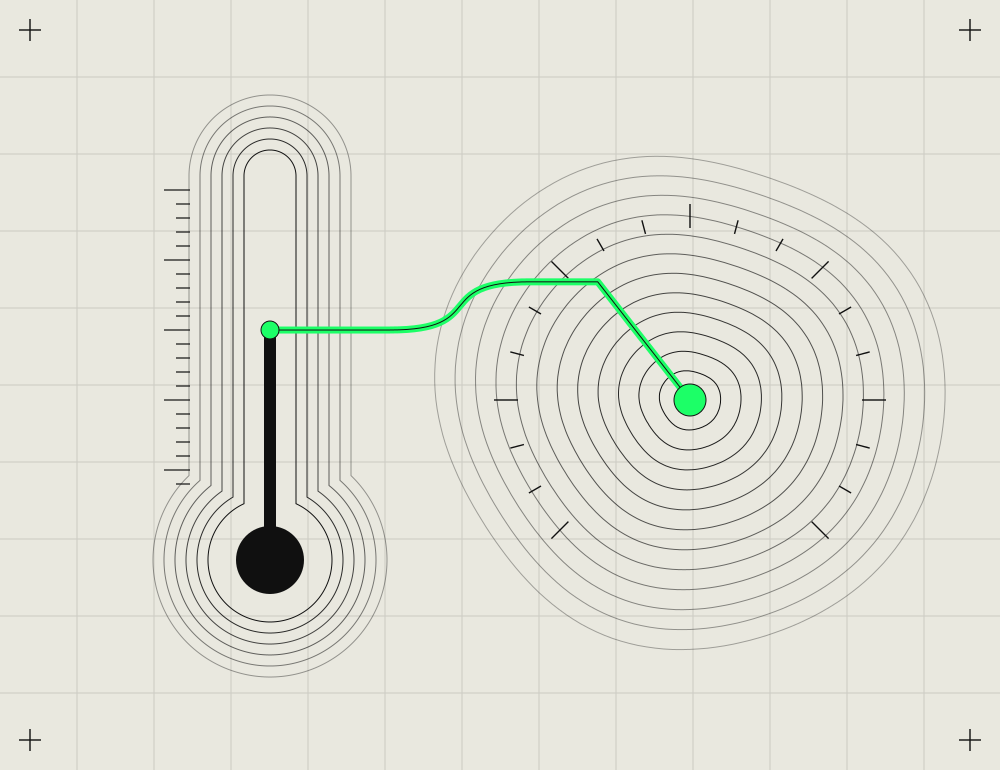
Europe's carbon market works because every tonne measured costs an allowance, and nobody has to hold a meeting. Its sustainability reporting directive has no such wire: a company can report rising emissions for years and nothing follows. The essay argues that Europe regains climate leadership by wiring the numbers it already collects to decisions that already get made, starting with what the ECB lends against and what a bank's credit file shows. Then it widens the accounts to soil and water, and makes measuring cheap enough to do so.
What happens after a large company counts (and accounts for) a tonne of carbon? Under Europe’s carbon cap, the emitter has to surrender an "allowance" for it, and because the cap shrinks every year, an emitter that runs short must buy more on the market.
This mechanism works. The power plants, steel mills and cement kilns under the cap now emit, taken together, about half of what they emitted in 2005, and most of the cut came from power.1 Some emissions probably shifted abroad, granted, though most studies find the effect small. Even counting the emissions in what Europe bought from abroad, its consumption footprint fell by about 14% between 2010 and 2022.2 (Not enough, but the direction is right.)
Now contrast that with what happens after a large company publishes a sustainability report under Europe's new reporting directive. Depressingly, most of the time nothing happens.
That difference is where I’d start with the European Forum Alpbach’s question about climate leadership. Europe already collects a great many numbers. But which ones actually change a decision and have an impact?
What Europe built
Since 2005, power plants and factories covered by the EU Emissions Trading System have had to measure their emissions, have them verified and give up one allowance for every tonne.3
The carbon market in the EU took a decade to bite. Allowances were in surplus from 2009, and by 2016 a tonne cost only about €5, a price at which no engineer redesigns a kiln.4 A reserve that removes surplus allowances began in 2019, and by 2025 the average auction price was €73.3
Heavy industry received many of its allowances free, which softened the consequence for steel and cement.5 The risk of outsourcing is greater in industries such as steel and cement, where imports can replace production at home, and since January 2026 a carbon border adjustment has begun to close that loophole too.6 Slightly awkward, but it puts a price on the tonne wherever it was emitted. That gives a producer abroad a reason to measure its own emissions.7
It's a success story. Carbon pricing keeps spreading: the World Bank counts 87 systems this year, covering just over 29% of global emissions and raising more than $107 billion in 2025.8 Britain added its own carbon price floor in 2013, and coal fell from 46% of its power in 2012 to 3% by late 2016.9
The wire
Step back for a moment and think about your home in winter. A thermostat reads 19 degrees and the boiler fires. Nobody holds a meeting. You don't do anything. Control engineers call this a closed loop: a measurement and a consequence that follows, without anyone deciding each time.
The carbon market is built this way, and so are other rules. An installation that emits a tonne gives up an allowance, and one that holds too few pays. This is the market and it has rules. Bank supervisors know the feedback design well: under the Basel rules, a bank that eats into its capital conservation buffer of 2.5% faces automatic limits on dividends, buybacks and bonuses.10
Then there is the Corporate Sustainability Reporting Directive.
Take a company that reports rising emissions five years in a row. What happens? One thing happens automatically: its report gets longer. That's about it.
Nobody planned it that way. The directive was meant as the sensor of a larger "machine", in which fund managers would disclose what they held, the taxonomy would define which activities count as green, and the price of capital would carry the reading back to the company. The sensor was built with great care (and ignorance of how things work in reality). EFRAG consulted widely in 2022, on what companies should disclose, not on who would act on the answer.11 The sensor grew. The machine around it was never finished.
And now we are stuck with an expensive sensor. The first companies to report were Europe's large listed companies, banks and insurers. In a survey published by EFRAG, they put the cost of the first report at about €287,000 for companies below 10,000 employees and about €1.97 million above, and €202,000 and €1.37 million for every year after.12
Europe has run the experiment in another field. The Stability and Growth Pact allows fines for excessive deficits. Since 2011 a fine counts as adopted unless a qualified majority of the Council blocks it,13 which is close to automatic. But the Commission must first recommend it, and in 2016 it recommended cancelling the fines for Spain and Portugal.14 No fine has ever been imposed for an excessive deficit. The only fines under the Pact's rules, on Spain in 2015 and Austria in 2018, punished misreported statistics.15 The wire fired for false numbers, never for bad ones.
What the accounts leave out
One of the oldest measurements in business with a consequence built in is depreciation: an accountant estimates the wear on a machine and charges it against profit every year, whether or not anything has broken. By contrast, a river the business depends on can deteriorate for years before its cost shows up in any account.
On 22 October 2018 the gauge at Kaub on the Rhine read 25 centimetres, then the lowest daily value on record.16 BASF cut production at Ludwigshafen and later reported that low water had lowered its earnings for the year by around €250 million.17 The Kiel Institute estimated that the low water took 0.1 percentage points off German growth in each of the last two quarters of 2018.18 On 14 August 2026 the same gauge showed 8 centimetres, 17 below the old record, and by October it had fallen below zero. The Kiel Institute's early estimate put the loss in the third quarter at €1 to 2 billion.19
The river is one vector among several. The Commission says 60 to 70% of the Union's soils are in an unhealthy state.20 Eastern Baltic cod has been closed to directed fishing since 2020, and scientists advise zero catch for 2027 and 2028.21 Spain's olive oil output fell from about 1.5 million tonnes to about 665,000 in one season, by the International Olive Council's figures.22
Where depletion stays off the books, part of what we call income is capital being consumed.
A firm that skipped the maintenance of its machines would be called out by its auditor. A continent can skip the maintenance of its soil and water for decades, and its headline accounts will show growth nevertheless.
Depletion is dependence
As always with sustainability, there is a security argument in this. What a country uses up at home it must later buy abroad, from whoever is selling, at the seller's price and on the seller's terms. Europe learned that with gas, and the lesson extends further, into the fields: nitrogen fertiliser is made from gas, and in 2024 Russia still supplied about 30% of the Union's nitrogen fertiliser imports, according to Commission market data.23
The ECB has put numbers on Europe's dependence on nature: 72% of euro-area companies depend critically on ecosystem services, those companies hold about three quarters of corporate bank loans, and more than 34% of bank loans, over €1.3 trillion, sit in sectors at high risk from water scarcity, so that in the Bank's own model a drought of the kind expected once in 25 years puts nearly 15% of output at risk.24 And when a climate catastrophe strikes, only about a quarter of the losses in the EU are insured, by the count of the ECB and the insurance supervisor, which leaves the rest with households and treasuries.25
The measurement exists. The wire is missing.
Wire first
So wire first, before anything new is measured. Every number that stays in the law should have a wire. I suggest two places to start.
The first is what the ECB lends against. Since June 2026, its climate factor has reduced the collateral value of corporate bonds exposed to the transition. In the ECB’s example, a €100 bond counts for €90 after the usual haircut and about €88 after the climate adjustment. The ECB expects little immediate effect because banks rarely borrow against corporate bonds.26
Make the adjustment larger where the risk warrants it, and let it reflect verified investment that reduces a company’s exposure to the transition. Apply a cautious default where the data are missing, as at the border. One caution: the Omnibus dropped the planned move from limited to reasonable assurance,27 and if money rides on a lightly checked number, companies will move the number.
How the ECB's climate factor works
- A commercial bank needs cash. It borrows the cash from the ECB.
- The ECB does not lend without security. The bank must hand over assets as security. These assets are called collateral. Company bonds are one type of collateral.
- The bank hands over a company bond with a value of €100.
- The ECB never lends the full value. It subtracts a safety margin, called a haircut. With a 10% haircut, the bank gets €90.
- Since 15 June 2026, the ECB subtracts a second amount, the climate factor. This amount is larger for a company that is more exposed to the climate transition.
- In the ECB’s example, the factor is 0.978. The bank now gets €88.26
The second wire is the credit file. A bank that lends to a farm, a brewery or a chemical plant above a falling water table should treat that dependence the way it treats deferred maintenance: a cash call that is coming and not yet booked. European banks have had to manage environmental risks under guidelines of the European Banking Authority since 11 January 2026.28 The credit file is where that duty should show.
A brewery and its well
- A brewery wants a loan of €10 million for 10 years. It pumps its water from its own well.
- The bank opens a credit file. This file holds the facts that the bank uses to decide on the loan.
- The file shows a profit of €1.5 million a year. The loan costs €1.2 million a year in interest and repayment. The loan looks safe.
- The water level under the brewery falls by 1 metre each year. In about 6 years the well will be dry at its current depth.
- The brewery must then drill deeper or buy water from a supplier. This will cost about €2 million.
- Today the credit file does not show this €2 million. The brewery’s accounts do not show it either, because no invoice exists yet.
- Spread the €2 million over the 6 years, and the brewery has about €1.17 million a year for a loan that costs €1.2 million. The loan no longer looks safe. The bank should price the well in, or ask for a reserve.
Make measuring cheap
But a continent that wants to book soil, groundwater and rivers as well as carbon has to bring down the price of measuring. Measurement should be public infrastructure. The state should publish the factors, the method and the tool, much like it publishes the land register and the metre, and companies add their own data.
Pieces of this already exist: France’s Base Empreinte makes emissions factors freely available to anyone who registers,29 and EFRAG offers a free workbook for the EU’s voluntary sustainability reporting standard, along with an open-source converter that turns it into a digital report.30
Publish the calculation rules as code, too. A clothing maker can already enter the details of a garment into France’s Ecobalyse and get a score calculated using the official method.31 A small firm runs the same calculation as a large one, and an AI assistant could gather the inputs and run it for either.
Timing and order
Europe cut the reporting directive because it cost too much, at a moment when industry was already under pressure, and to ask now for more measurement, with automatic penalties attached, would drive industry out and lose the voters who are left.
A consequence that hurts creates the lobby against it. Flights to other continents were taken out of the carbon market in 2012, and the exemption was extended in 2014 to ease tensions abroad.32 Carmakers won the right to average their fleet targets over three years.33 The carbon market for buildings and road fuel now starts a year later than planned.34 Tie costly reporting to tougher consequences and Europe risks losing both investment and political support.
The solution to this is to change the order. Start with figures companies already collect and decisions that lenders already make. Retire disclosures that serve no clear decision. Widen the rules once measurement is affordable and there is evidence that the consequences work as intended.
Rules that act
Before Europe asks for another number, it should be able to say who will use it and what they will do differently.
Then the thermometer Europe spent twenty years building will at last be wired to a thermostat, and its readings will act on both the emissions and the dependence that leaves Europe exposed.
Checked 16 November 2026, checked again 17 November 2026.
Notes
European Environment Agency, EU Emissions Trading System emissions. Emissions from stationary installations are down 51% since 2005, most of it from power.
Eurostat, EU greenhouse gas footprint: 10.7 tonnes per capita, news release, 19 February 2025: the EU's consumption-based footprint fell 14% between 2010 and 2022, emissions from production in the EU 18%. Note: the smaller fall in the footprint is consistent with some emissions shifting abroad, but the release does not attribute the gap. Tero Kuusi and Maria Wang, Trade Flows, Carbon Leakage, and the EU Emissions Trading System, ETLA Working Papers No. 94, August 2022: earlier studies "mostly shown small or nonexistent carbon leakage"; with OECD trade data the authors find some leakage, seen in a higher CO2 intensity of EU imports.
ICAP, EU Emissions Trading System factsheet: linear reduction factor 4.3% (2024–2027) and 4.4% (from 2028), Market Stability Reserve operating since 2019, average 2025 auction price €73.43. European Commission, About the EU ETS: 62% below 2005 by 2030.
European Commission, Market Stability Reserve: a large surplus built up since 2009. European Environment Agency, Trends and projections in the EU ETS in 2017, Report 18/2017: 2016 prices fluctuated around €5.
Carbon Brief, Q&A: What the EU's carbon market review means for climate action, 20 July 2026: about 43% of allowances are given free. Free allocation was due to fall from 2026 and end by 2034 as CBAM phases in. A Commission proposal of 17 July 2026 would extend it to 2038. Note: the 43% is a share of all allowances, not of industrial emissions.
European Commission, DG TAXUD, Carbon Border Adjustment Mechanism. Definitive regime from 1 January 2026, sectors as listed.
European Commission, DG TAXUD, CBAM legislation and guidance: default values in Implementing Regulation (EU) 2025/2621, corrected by (EU) 2026/1740. Defaults carry mark-ups of 10% (2026), 20% (2027) and 30% (from 2028) for most goods. Note: the mark-ups were read in secondary guides (for example IISD), not on the DG TAXUD page.
World Bank, Direct carbon pricing covers nearly one third of global emissions, press release, 19 May 2026.
Policy Exchange, Next steps for the Carbon Price Floor, research note by Richard Howard, November 2016. UK Carbon Price Support introduced in April 2013 on top of an EU ETS price of about €5. Coal's share of UK generation fell from 46% in 2012 to 3% in the third quarter of 2016, which the note attributes to the price support.
Basel Committee on Banking Supervision, Basel Framework, RBC30: Buffers above the regulatory minimum. Buffer of 2.5% of risk-weighted assets in CET1. Distribution limits apply automatically inside the buffer.
EFRAG, Public consultation on the first set of draft ESRS: consultation from 29 April to 8 August 2022, mostly by online survey, with 16 outreach events and close to 5,000 registrations.
EFRAG, Updated cost-benefit analysis on the amended ESRS, February 2026. Wave-1 reporters: €287,000 and €1,972,000 in the first year, €202,000 and €1,365,000 recurring.
Regulation (EU) No 1173/2011, Article 6: a fine is "deemed to be adopted by the Council unless it decides by a qualified majority to reject" the Commission's recommendation within 10 days.
Public Affairs Bruxelles, Excessive deficit procedure: Council agrees to zero fines and new deadlines for Portugal and Spain, August 2016: the Commission proposed on 27 July 2016 to cancel the fines, and on 8 August 2016 the Council did not reverse that proposal.
Council Decision (EU) 2015/1289 of 13 July 2015: a fine of €18.93 million on Spain for misrepresenting deficit data in the Valencia region. Council Implementing Decision (EU) 2018/818 of 28 May 2018: a fine of €26.82 million on Austria for misrepresenting debt data in Land Salzburg. Both fines rest on Article 8 of Regulation (EU) No 1173/2011, which covers misreported statistics, not Article 6, which covers deficits.
Wikipedia, Pegel Kaub: 25 cm on 22 October 2018, below the earlier record of 35 cm (2003).
BASF, news release P-19-141, February 2019: reduced plant utilisation at Ludwigshafen, about €250 million of lost earnings in 2018.
Kiel Institute, Kiel Economic Report No. 50, Germany, 2018 Q4: growth dampened by 0.1 percentage points each in the third and fourth quarters of 2018.
VerkehrsRundschau, Pegel Kaub erreicht historischen Tiefstand, August 2026: 8 cm on 14 August, raw BfG data. Note: Wikipedia (Pegel Kaub) lists later lows down to −6 cm on 1 October 2026, not confirmed by the BfG. VerkehrsRundschau, Rhein erreicht neue Rekordtiefs, 1 October 2026: negative readings were registered at times. Cleanthinking, Niedrigwasser: Was der niedrige Rhein-Pegel die Wirtschaft kostet, 1 September 2026: Stefan Kooths of the Kiel Institute put the lost value added in the third quarter at roughly €1–2 billion, 0.1–0.2% of GDP, in early August.
European Commission, DG Environment, Soil health.
ICES, advice for eastern Baltic cod: zero catch for 2027 and 2028. FishSec, EU set TAC quotas for the Baltic Sea region, 22 October 2020: directed fishing banned, by-catch quota only.
International Olive Council, Highlights of the World of Olive Oil, no. 118, December 2023: Spain 1,491,500 t (2021/22) and 665,800 t (2022/23).
European Commission, Fertilisers Market Observatory, Update on imports of urea and other fertilisers, 9 September 2025: Russia's average share of EU nitrogen fertiliser imports was 30% in 2024. Note: that nitrogen fertiliser is made from gas is general knowledge and not taken from this document.
European Central Bank, blog of 23 May 2025.
ECB and EIOPA, Policy options to reduce the climate insurance protection gap, discussion paper, April 2023.
European Central Bank, Climate factors: how the ECB tackles climate uncertainty in its collateral framework, blog, 7 July 2026. In force since 15 June 2026. The stated aim is to protect the ECB's balance sheet against climate transition shocks. A firm's exposure is scored on greenhouse gas emissions, decarbonisation targets and the quality of climate disclosure. The immediate effect is expected to be limited because of low current borrowing and limited use of corporate bonds as collateral. Worked example: €100 × (1 − 0.10) × 0.978 ≈ €88.
Arendt, Omnibus I is final: clarity for businesses on sustainability obligations: limited assurance remains the standard, and the requirement to adopt reasonable assurance standards has been removed. Note: law-firm summary.
European Banking Authority, EBA publishes its final Guidelines on the management of ESG risks, 9 January 2025. Apply from 11 January 2026, small and non-complex institutions by 11 January 2027. The guidelines add no minimum (Pillar 1) capital requirement. They link ESG risks to the banks' internal capital assessment.
ADEME, Base Empreinte.
EFRAG, VSME digital template and XBRL taxonomy: version 2.0.0 published 4 November 2026, converter open source under the MIT licence.
Ecobalyse, ecobalyse.beta.gouv.fr; summary: Projet Celsius, Ecobalyse, l'outil d'affichage environnemental textile: the state calculator applies the method of the arrêté of 6 September 2025 and décret n° 2025-957.
Transport & Environment, EU governments dismantle emissions trading for international aviation, 5 March 2014: the one-year "stop the clock" of 2012 was extended, limiting the scheme to flights within the EU until 2016. France, Germany and the UK argued that this would ease tensions with foreign countries.
European Commission, CO2 emission performance standards for cars and vans: €95 per g/km per new vehicle, new-car CO2 down 28% from 2019 to 2024, compliance averaged over 2025–2027 under Regulation (EU) 2025/1214, adopted 17 June 2025.
European Commission, ETS2: buildings, road transport and additional sectors: fully operational in 2028. The one-year delay from 2027 was agreed in November 2025 with the 2040 target: ICAP, EU reaches agreement on 2040 climate target, postpones ETS 2 one year.