Ask how much better AI has become at mathematics in the last two years, and you will get a number. Ask how much better it has become at writing, and you get a shrug.
I have some sympathy for the shrug. Part of my job was to read drafts written by an LLM for companies reporting under Europe’s sustainability standards.1 I decided which answers could go in front of a client, which needed work and what to change in the prompt so we would see fewer of the same mistakes. So, lazy as I was, I thought I could hand the judging to another LLM, and I sat down to write the definitions, a rubric, that this judging agent could score against: is the answer accurate, does it cover the required datapoints, is it concise, does it cite its sources?
This worked, until it didn't. Two questions could sit in the same topic, climate change, and require opposite things.
- One asked whether the company has a transition plan for climate change mitigation,2 and a good answer there was short and committal: yes or no, adopted when, approved by whom.
- The other asked how the company's emission targets compare with limiting warming to 1.5°C, and a good answer there needed reasoning, caveats and a careful line between what the company claims and what its numbers support.
Concision helped the first answer and hurt the second.
Each new question asked for a new definition of good. I kept adding criteria and the rubric kept growing, and all the while I could still tell a good answer from a weak one at a glance, usually before I could name the criterion it failed. My definitions trailed behind my judgement like a tired dog behind its master.
Why would the machines race ahead like greyhounds on the maths track while their progress in prose and judgement goes almost unmeasured? Is writing simply harder? Did the data run out? Or is something stranger going on, something about what it means to measure a good answer at all?
Where the machines got better
My small rubric problem turned out to be a local copy of a much larger one. For years, AI models improved by growing, with more text and more computing power, but by late 2024 that method was paying back less and less, and in December of that year Ilya Sutskever, a co-founder of OpenAI, told the NeurIPS conference that pre-training as the field knew it would end, because there is only one internet of human text to learn from.3 So the labs took a second road. They trained models to reason step by step and rewarded them whenever the final answer was correct, which works wherever a computer can check the answer, where a proof holds or fails and code passes its tests or doesn't, and in exactly those fields the results came fast.
FrontierMath has 4 tiers and Tier 4 is the hardest, the type of problems that professional mathematicians try to solve in their research. By March 2026 a single model, GPT-5.4 Pro, was solving half of the first three tiers,4 and in September 2026 a model solved 2 of 68 previously unsolved research problems in the separate FrontierMath Erdős test, with both solutions verified by a computer proof checker.5
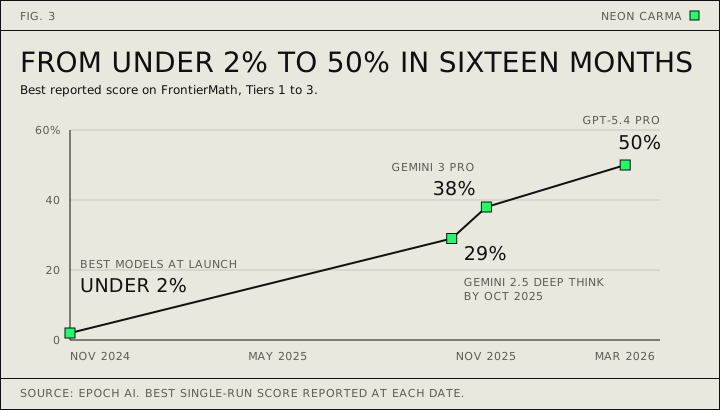
Best reported score on FrontierMath, Tiers 1 to 3. Source: Epoch AI.6784
The International AI Safety Report 2026 says as much.9 Most of the evidence on what reasoning techniques achieve, it notes, still comes from mathematics and programming, experts disagree on whether the gains will spread further, and in the fields where answers are "harder or impossible to verify", creative writing, strategic planning, scientific hypotheses, the method of training on answers the model checked itself risks model collapse, with errors compounding from one generation of training to the next.
Take writing. Epoch AI hosted a creative writing benchmark built by the researcher Lech Mazur,10 in which each model wrote short stories that wove ten assigned elements together, and seven AI graders scored every story against a 16-question rubric to give a number from 0 to 10. The last leaderboard of that version came out on 8 August 2025. Later versions dropped absolute grades, and the grader models now read two stories side by side and pick the better one, which is why Epoch stopped updating its page. Ratings of that kind only rank a model against whichever other models happen to be in the pool, and in Epoch's words they have
"no stable correspondence to an absolute level of performance."
So the people whose job is to measure AI writing have stopped saying how good a story is, and say only which of two stories is better.
Recognised before explained
Robert Pirsig wrote a whole book about why that might be. Zen and the Art of Motorcycle Maintenance came out in 1974,11 and it follows a father and his son on a motorcycle trip across the American West, while underneath runs an inquiry into one word: Quality. His test is simple enough to try at the kitchen table. Read two versions of a paragraph that carry the same information, and one of them will be clearer and more alive, and you will know which at once, before you can say why.
Rules describing quality come later. They describe our judgement, test it, refine it and help us teach it, but they don't account for where it came from, and Pirsig's narrator, a former teacher of rhetoric,12 spends years trying to define Quality, and failing, while he and his students go on recognising it in each other's writing.
A first impression can be wrong, he grants, but experience and close attention train judgement over time, the way a mechanic with twenty years at the bench hears faults in an engine that a beginner misses. So he leaves room for both, the immediate recognition and the disciplined examination that follows it, and then he makes an almost mystical claim.
Quality is an event
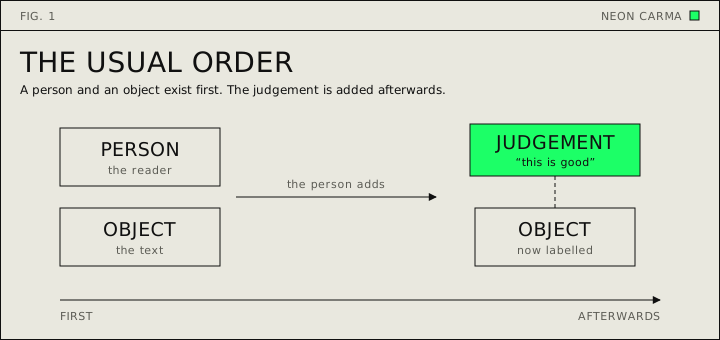
We usually picture three pieces: a person, an object, and a judgement the person adds to the object afterwards.
Pirsig reverses the order. The encounter comes first, and the splitting of it into "me", "the thing" and "my judgement" happens later. In his words:
"Quality is not a thing. It is an event."
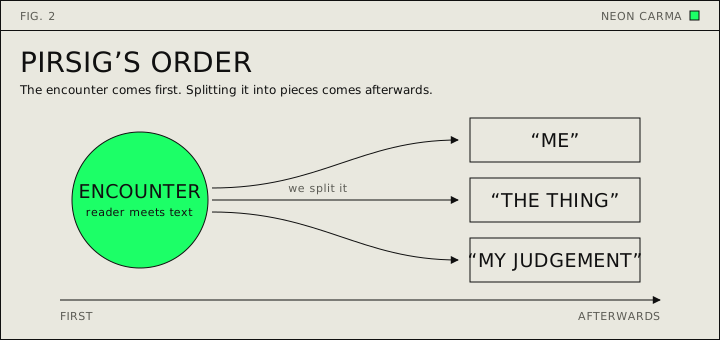
Quality is the moment a reader meets a text or a rider meets a motorcycle, the moment of awareness before we cut the experience into subject and object. That, I realised, was my rubric problem in one line.
A good answer is good for a question, and the question is half of the event.
The "transition-plan answer" and the "1.5°C answer" were about the same company and the same topic, but the questions differed, so the meetings differed, so what counted as good moved with them, while my rubric, written in advance and without context, was trying to settle the quality of answers before anyone had asked the question.
One sentence, four questions
The question shapes what an answer means as well as how good it is. Take Ram Dass's mantra, "I am loving awareness," and say it aloud four times, stressing a different word each time:
- What are you? "I am loving AWARENESS."
- What kind of awareness? "I am LOVING awareness."
- Are you, really? "I AM loving awareness."
- Who is loving awareness? "I am loving awareness."
On the page all four are the same sentence. Spoken, each one answers a different question, and a small lift of the voice tells the listener which question was asked. Take away the voice and the question, and the text alone cannot tell you which answer you are holding, which is exactly where a definition stands: it reads the text, and the meaning sits outside it.
The finger and the moon
In a Buddhist image, a teacher points at the moon and the student studies the finger. In AI terms a definition is a finger, and so are a benchmark, a reward model and a test suite, each one a record of a judgement someone once made: this kind of answer was good, for those questions, at that time. Where the finger points straight, as with a maths problem that has one correct answer, a model that satisfies the finger reaches the moon as a matter of course, which is why reasoning models climbed so fast in maths and code. Where quality depends on the question, the record covers only the questions asked when it was made, and the next question meets a moon that has moved.
Evaluation carries a paradox: measurement can only hold quality that has already happened. Better scoring and longer reasoning improve the record without ever turning it into the event. Pirsig named the two sides in his second book, Lila (1991):13 Static Quality, the patterns that have been fixed and can be repeated, and Dynamic Quality, which he held to be indefinable. Every measurement sits on the static side, and each new question arrives on the dynamic one.
Write the perfect rubric for one question, then for every question in one ESRS topic, then for every question a client, a regulator or a curious child might ever ask. Each step needs criteria for the new questions, and somewhere along the way the rubric grows as long as the questions it covers, like the map in Borges's short story that was drawn at the full scale of the empire, covered it completely, and was of use to no one.
The gap also widens as quality rises. A poor answer usually fails something checkable, a wrong figure, a missing datapoint, a broken citation, while a good answer passes those checks, and what separates it from an excellent one is mostly its fit to this question and this reader.
When the measure becomes the target
In 1975 the economist Charles Goodhart, writing about British monetary policy, observed that a statistical regularity tends to collapse once policymakers use it as a control target, and in 1997 the anthropologist Marilyn Strathern gave it the form most people know: "When a measure becomes a target, it ceases to be a good measure."14
AI research now runs Goodhart's experiment daily. Models trained against a grader learn what the grader rewards, which drifts away from what the grader meant. Automated judges, for example, tend to prefer longer answers, so benchmark designers had to build corrections for length,15 and my own rubric would have gone the same way: a model trained to score well on "covers the required datapoints" learns to list datapoints, whether the question needed them or not.
Admittedly, the strongest case against all this comes from how chat models are trained. In reinforcement learning from human feedback, people read two model answers and pick the better one, and the model learns from millions of those choices, which is Pirsig's two-paragraph test run at industrial scale, so one could argue that the models learn recognition itself. But what they learn is a record of it. Every choice in the training data was a Quality event between a particular rater, a particular question and two particular answers, and the training set keeps the outcomes and loses the events. The writing benchmark shows where that leads: a ranking that holds only inside its own pool.
What evaluators can do
Measurement still earns its place, as long as we know which part of quality it can hold. Automate what is fixed, the figures and the citations, because machines check these better than people do. For the rest, keep experts in the loop, question by question: show them two answers to the same question, ask which is better and why, and when they disagree, rewrite the rubric from their reasons, because the disagreement marks the spot where the definition was missing. And keep the human checks going, because as models pass every fixed check, what is left to judge is "fit to the question", and I suspect that will stay a matter of human judgement for a while yet.
The mechanic and the moving moon
Pirsig's good mechanic knows the manual and still listens to this engine on this morning, and the care is in the listening. Quality is the moon, and it moves each time someone asks a new question. Hand all of the listening to machines trained on yesterday's judgements, and we will build evaluators that are always right about where the moon used to be.
Notes
Footnotes
-
European Commission, Commission Delegated Regulation (EU) 2023/2772 supplementing Directive 2013/34/EU as regards sustainability reporting standards (ESRS), 31 July 2023. https://eur-lex.europa.eu/eli/reg_del/2023/2772/oj ↩
-
ESRS E1 Climate change, disclosure requirements E1-1 (transition plan for climate change mitigation) and E1-4 (targets, including compatibility with limiting warming to 1.5°C), in Delegated Regulation (EU) 2023/2772. https://eur-lex.europa.eu/eli/reg_del/2023/2772/oj ↩
-
Ilya Sutskever, test-of-time award talk, NeurIPS 2024, Vancouver, 13 December 2024, as reported in Computing, "Genuinely intelligent AI will be unpredictable, warns former OpenAI chief scientist". https://computing.co.uk/news/2024/ai/sutskever-warns-ai-will-become-less-predictable ↩
-
Epoch AI, "The Epoch Brief, March 2026". https://epochai.substack.com/p/the-epoch-brief-march-2026 ↩ ↩2
-
Epoch AI, "Announcing FrontierMath Erdős", September 2026. GPT-6 Astra solved 2 of 68 problems that were open as of August 2026, with proofs or disproofs verified in Lean. Each attempt allowed up to $300 and 72 hours. https://epoch.ai/latest/announcing-frontiermath-erdos ↩
-
Elliot Glazer et al. (Epoch AI), "FrontierMath: A Benchmark for Evaluating Advanced Mathematical Reasoning in AI", arXiv:2411.04872, 7 November 2024. https://arxiv.org/abs/2411.04872 ↩
-
Epoch AI, "Less than 70% of FrontierMath is within reach for today's models", 17 October 2025. Best single run seen at that date: 29%, Gemini 2.5 Deep Think. https://epoch.ai/gradient-updates/less-than-70-percent-of-frontiermath-is-within-reach-for-todays-models ↩
-
Epoch AI, "FrontierMath Tiers 1–3 (v1)" benchmark page: Gemini 3 Pro at 38%. The page gives no date; the chart places the score at the model's release month. https://epoch.ai/benchmarks/frontiermath-tiers-1-3-v1 ↩
-
International AI Safety Report 2026, arXiv:2602.21012 (section on reasoning capabilities). https://arxiv.org/abs/2602.21012 ↩
-
Epoch AI, "Lech Mazur Writing" benchmark page (frozen at the leaderboard of 8 August 2025). https://epoch.ai/benchmarks/lech-mazur-writing ↩
-
Robert M. Pirsig, Zen and the Art of Motorcycle Maintenance: An Inquiry into Values (New York: William Morrow, 1974). ↩
-
Pirsig 1974, chapter 16 (Phaedrus's rhetoric course and withheld grades); https://www.litcharts.com/lit/zen-and-the-art-of-motorcycle-maintenance/chapter-16 ↩
-
Robert M. Pirsig, Lila: An Inquiry into Morals (New York: Bantam, 1991). Summary of Static and Dynamic Quality and the four static levels: https://en.wikipedia.org/wiki/Lila:_An_Inquiry_into_Morals ↩
-
C. A. E. Goodhart, "Problems of Monetary Management: The U.K. Experience", Papers in Monetary Economics, Reserve Bank of Australia, 1975; Marilyn Strathern, "'Improving ratings': audit in the British University system", European Review 5(3), 1997, pp. 305–321. ↩
-
Yann Dubois et al., "Length-Controlled AlpacaEval: A Simple Way to Debias Automatic Evaluators", arXiv:2404.04475, 2024. https://arxiv.org/abs/2404.04475 ↩